Tuesday, February 11, 2020

Thoptera

It's official.... Thoptera now has a website. www.thoptera.com Thanks to my business partner for setting that up and also for the cool new email address: john@grasshopper.farm How cool is that?!?!

Still been feeding grasshoppers everyday and hatching some new ones. Things should explode exponentially in the coming months. Still much experimentation, with more to come in the months ahead. The initial batch that was hatched in December is now beginning to breed and lay eggs. Here are a few photos of those.


I believe they are Melanoplus differentialis (Differential grasshoppers). I think I have a few Schistocerca americana as well in captivity. Some of the nymphs may be of that type as well. As they grow, it will be easier for a non-entomologist (like me) to identify them. 

I have noticed that these have not gotten as large as their parents, who were caught wild in the Fall (2019). I suspect that the diet and lighting may be the culprits. I will need to tinker more with lighting to see if that helps. I hope to have a greenhouse type structure, at least a building is many windows on the South side of the structure, to give them plenty of natural light year round. Light in the wintertime will need to be supplumented.

There is a major locust outbreak in Africa going on currently. 


Thursday, January 9, 2020

Thoptera Grasshopper Operation Ramping Up

Progress with the Thoptera grasshopper growing operation is ramping up. I posted in the fall about my interest in starting an alternative protein business focused on mass rearing of grasshoppers here in the U.S. In my research, I have yet to find a company in America that is involved in commercial grasshopper production. If you know one, please post in the comments. My aim is to continue working to optimize year round production of grasshoppers for human consumption and for agricultural feed purposes (poultry and aquaculture). Earlier posts contained pictures of grasshoppers that had been captured in the wild and then caged to breed. After some research and lots of trial and error to getting them to hatch I successfully hatched out a few dozen in December (obviously not within the normal seasonal hatching in North America). If all goes well, the next generation with yield several hundred, and the generation after that will be in the thousands by summer. This would allow for direct to consumer sales initially with a more commercial type operation to follow. I am sure there will be several more things to learn over the next few months, especially as the quantity increases. The goal is to have a commercial, year-round production system in place by next fall that can be scaled for growth as demand increases.
Check out this video of one group of itty-bitty grasshoppers emerging from their eggs in my "desktop hatcher."
Here is a photo of the same grasshoppers a few weeks later in the growth chamber.
The following photo shows the grasshoppers that were caught in the wild about 6 months ago.
 

Thursday, October 3, 2019

Swarms of grasshoppers

This year there was a swarm of grasshoppers in Las Vegas.
They were piled high there. It shows just how densely they can be congregated. These folks even rounded up a few to cook up and eat (although the newscasters didn't like the idea):
This next video really explains the swarming phenomenon well. It has really great video footage as well. Can we say Biblical?!!!?? The ability for them to be in close quarters may be beneficial in raising them in a closed environment on a large "industrial scale."

People around the world consume grasshoppers/locusts. The problem is that many of these "wild" grasshoppers are likely contaminated with pesticides/insecticides and other agricultural chemicals.
Central Americans especially love grasshoppers, called Chapulines! Many are imported to the U.S.! This silly video does a good job describing the basics of it....

One guy said "they taste like bacon bits." 😎😀😀

These videos help support the idea that I believe there is a market in the U.S. for commercially grown grasshoppers. I am still waiting for my little "swarm" of grasshoppers, which include several types, to multiply. They have been mating and laying eggs, which are now nearing week 2 in the incubator. I will provide an update on when/if there is success in hatching out baby grasshoppers!

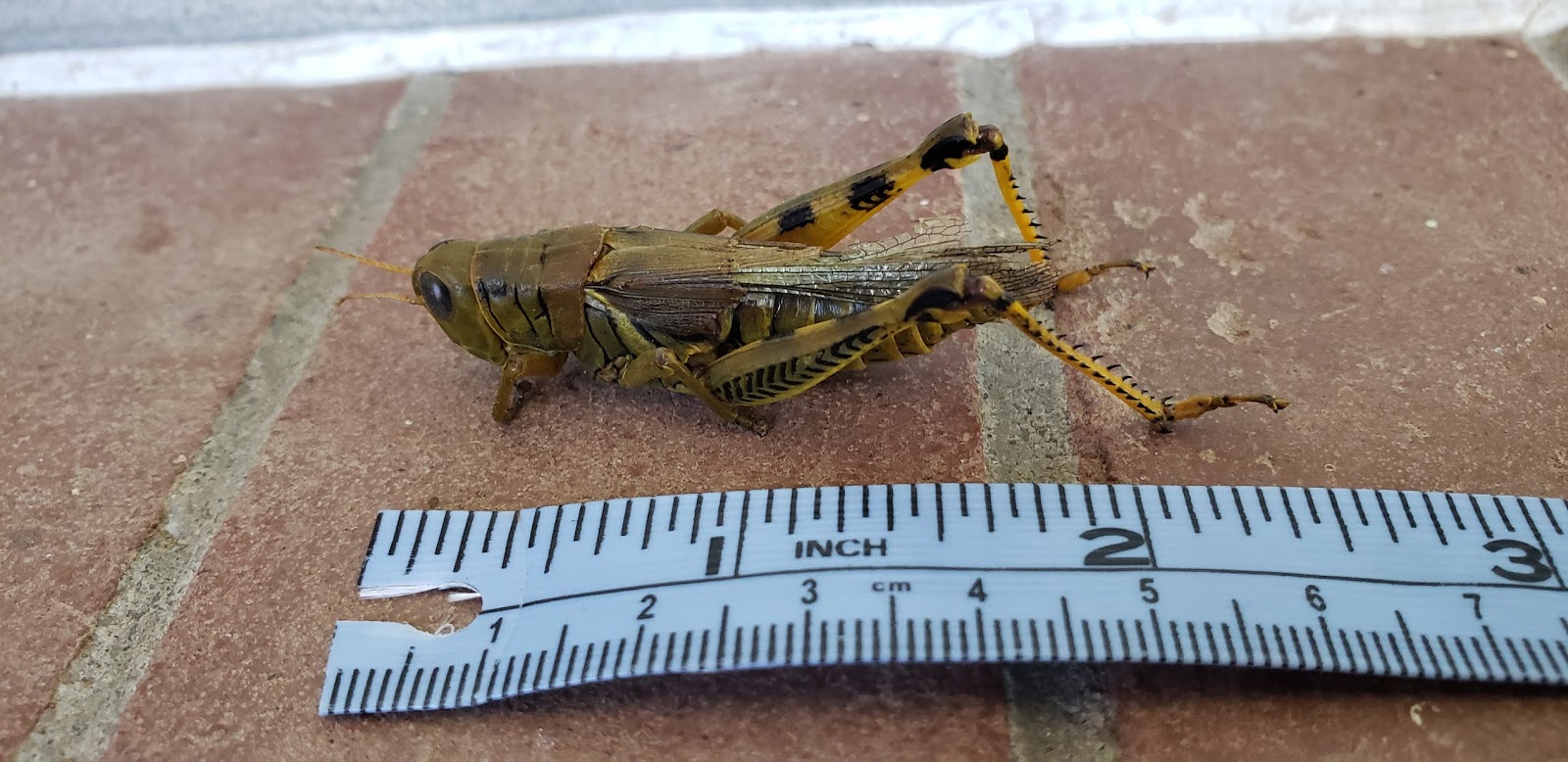
In the meantime, here is a pic of one that sadly reached end of life while in captivity. It gives you a good idea of the size.


Monday, September 23, 2019

Insect agriculture

I have been researching and tinkering with an idea that is new to me, but has apparently been a "thing" for several years: insect agriculture. There a good number of players in the space, most focusing on mealworms or black soldier fly larvae as protein sources. This article helped to spark my interest in the farming of insects: https://agfundernews.com/funding-insect-startups-slow-start-despite-demand.html. This article was a good one as well: https://agfundernews.com/inside-insect-farming.html.  It speaks to the need for automation in the space and how it drives growth. This is what has peaked my interest in the space. After some research on the topic (what I enjoy doing) and looking at the latest news and trends I took the plunge and started my own grasshopper "farm". My family and I have been rounding up grasshoppers from our small plot of land.
Here are a few photos and a video of our first grasshopper box....


We have captured several types of grasshoppers and have now begun the incubation process, attempting to hatch out new grasshoppers in captivity.

So why grasshoppers? I came across an Israeli company, Hargol, that happens to be the world's first and only commercial scale grasshopper producer. After reading up on grasshoppers, it was apparent that they would be a good challenge. Plus, they are also in demand. In Mexico, grasshoppers are a sought after critter. When prepared for human consumption they are know as Chapulines. I anticipate that there will be a sufficient demand in the southern US given that there is a large Hispanic population. Granted, the grasshoppers we are growing are not the native variety found in Mexico and Central America, but maybe these will be a good substitute  as "American Chapulines." Beyond direct human consumption they can also be made into protein powder/meal for use in both human, animal, and fish feed. Think tilapia, shrimp, and chickens. They could even be dried and feed whole to poultry.
So that is a rundown of a new adventure here at Mt. Pelia Innovative Solutions. Plans are already in the works related to how to scale up. I love to come up with company names. One that I like for this business is "THOPTER". This is derived from the insect order Orthoptera which includes locusts, crickets, and grasshopper.
What do you think of this new venture? Would you try a roasted grasshopper? How about a smoothie made with insect protein powder? Let me know in the comments section.
-John


Thursday, June 26, 2014

Product Ideas & Inventions

Mt. Pelia Innovative Solutions LLC would be pleased to partner with you in the design and development of your product or idea.

We have experience in machine and product design as well as manufacturing in the U.S. and overseas. Company owner, John Cole, is a licensed professional Mechanical Engineer with graduate degrees in Biosystems & Agricultural Engineering from the University of Kentucky. We have high-tech 3D CAD (Computer Aided Design) software and also own a 3D printer which can be used to produce small scale parts and prototypes using plastic.

We look forward to hearing from you regarding your idea. Please drop us a note via our Contact Us page. Include a short description of your product or idea.

We want to work with you to see if your product can be turned into a marketable product. We can provide a Non-Disclosure Agreement to protect both parties, if desired, before we hear about your idea.

Wednesday, March 12, 2014

Bird Control Robots

We are still working on commercializing the patented technology we licensed from LSU AgCenter a few years ago. In fact, a good amount of progress has been made in the programming portion of the program over the last few weeks. We hope to have a system, which will be tethered, not autonomous, out for some tests runs in the next few weeks.

From there we will see what interest develops and proceed to work on the fully autonomous and/or remote controlled versions. We already have computer hardware and software lined up for autonomous navigation, which will be Arduino based. We have a hardware (motors, remote controller) platform on the drawing board.

I ran across a interesting article covering the South Korean bird scaring robot that has been in development by their military.

Sunday, January 5, 2014

A New Year.... Let's get something done!

2014 is in full swing now. I have put my first semester as a Lecturer of Agriculture at the University of Tennessee at Martin in the books.  I started there full-time in August of 2013. I have been teaching several courses in Agricultural Engineering Technology, classes on irrigation, hydraulics and ag engineering.  W teach some of these and more beginning this week.

Our first year operating the Lee Manufacturing Company also came to a close on December 31, 2013. We added the business as a "part" of Mt. Pelia Innovative Solutions LLC (it is actually named as a secondary name or dba of Mt. Pelia). The year went well, with hardly any loss of sales volume from the previous owner. Many lessons were learned and we even managed to turn a very small profit after the government gets its share.  I think 2014 will bring some solid improvements and hopefully a better profit. We are working on getting our corn cutters and pea shellers into some larger stores and markets.  We also hope to develop some new products that we can add to our lineup, maybe with a better profit margin.

As far as Mt. Pelia Innovative Solutions goes, not much materialized in 2013. Many projects were visualized and placed on the drawing board, but with the addition of the Lee portion of the business, most of the projects were put on the back burner. Especially when I began work at the university.

Some projects we are looking at are:

1. bird scaring robotic boat (licensed from LSU a few years back)
2. propane cannon (bird scaring product)
3. duck decoy (motorized)
4. numerous bird scaring devices
5. lots of websites
6. nutcracker devices

There are others too. Plus I do some periodic consulting for other companies.

I'm also working with the university to design and install a small irrigation system at a local farm for vegetable plots.  Good project, jut not much time to do it.

We lease a warehouse over in Union City to handle storage of our products.  I would like to in the next year or so get a structure ready to be able to house everything here in Martin. The photo below shows the inside of the Union City warehouse with not much in it, early last year.
I would like to get one of the big barns on our property fixed up enough to use it. It is a barn that was once used for equipment storage, tractors and maybe hay.  It is in bad shape now, but could possibly be repaired enough to get by. I might put in a gravel floor, as it is now dirt, and put in a gravel driveway up to it.  The big problem is unloading semi-trucks.  Maybe a good all-terrain fork truck can be found or possibly a skid steer with forks. That will be something to look out for this year.  

There is much to do this year. We hope this is the year that Mt. Pelia Innovative Solutions LLC will begin to really spread it's wings.  There is much to do....................
John