Tuesday, April 14, 2020

Mass Casualities

Things have been humming along nicely with the indoor grasshopper growth work of Thoptera. If you have been following along with previous posts, you know that an initial small batch of grasshoppers nymphs hatched in December 2019 from wild caught grasshoppers from Fall 2019. These egg pods were incubated indoors and eventually hatched. In March another batch hatched from these original eggs. The total number was nearly 300. That was in addition to the couple of dozen from December. The December batch has matured and has been actively laying egg pods for a few weeks and are nearing the end of their reproductive period. In the meantime the later (more numerous) batch has been consuming large amounts of store-bought romaine lettuce hearts. They have been growing quickly thanks to plenty of food and improved temperature and lighting resources, which include both UVA and UVB.

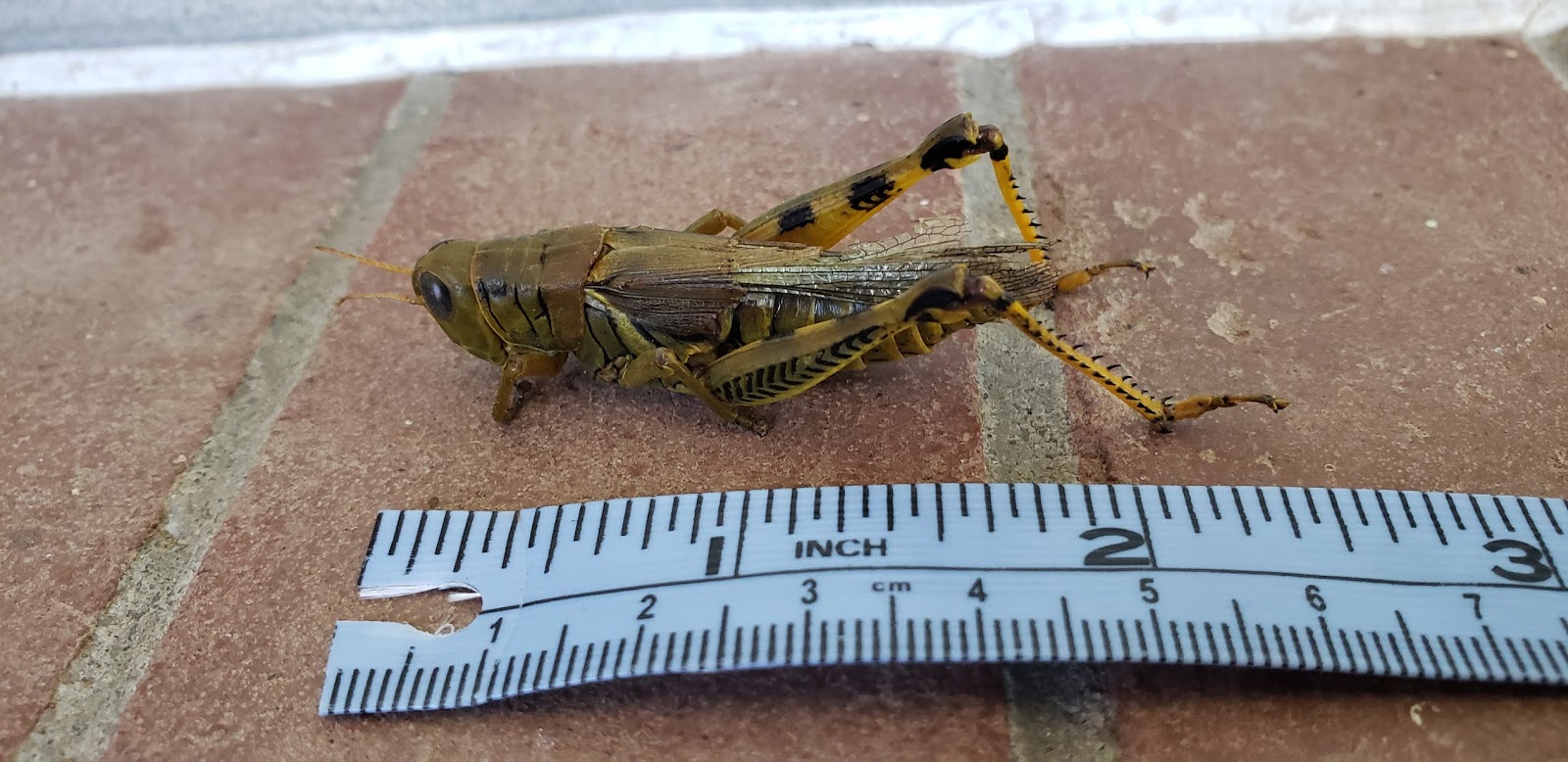
Adult Melanoplus differentialis (notice wings are present).
A new venture like this is always about experimentation and learning. Months back I experimented with some other food types. These included other lettuce types, turnip greens, collards, etc. While the grasshoppers seemed to like the variety to a degree, based on consumption, they always seemed to gravitate back to the romaine lettuce. As a consequence, I have stuck primarily with this food source along with plenty of dry bran.
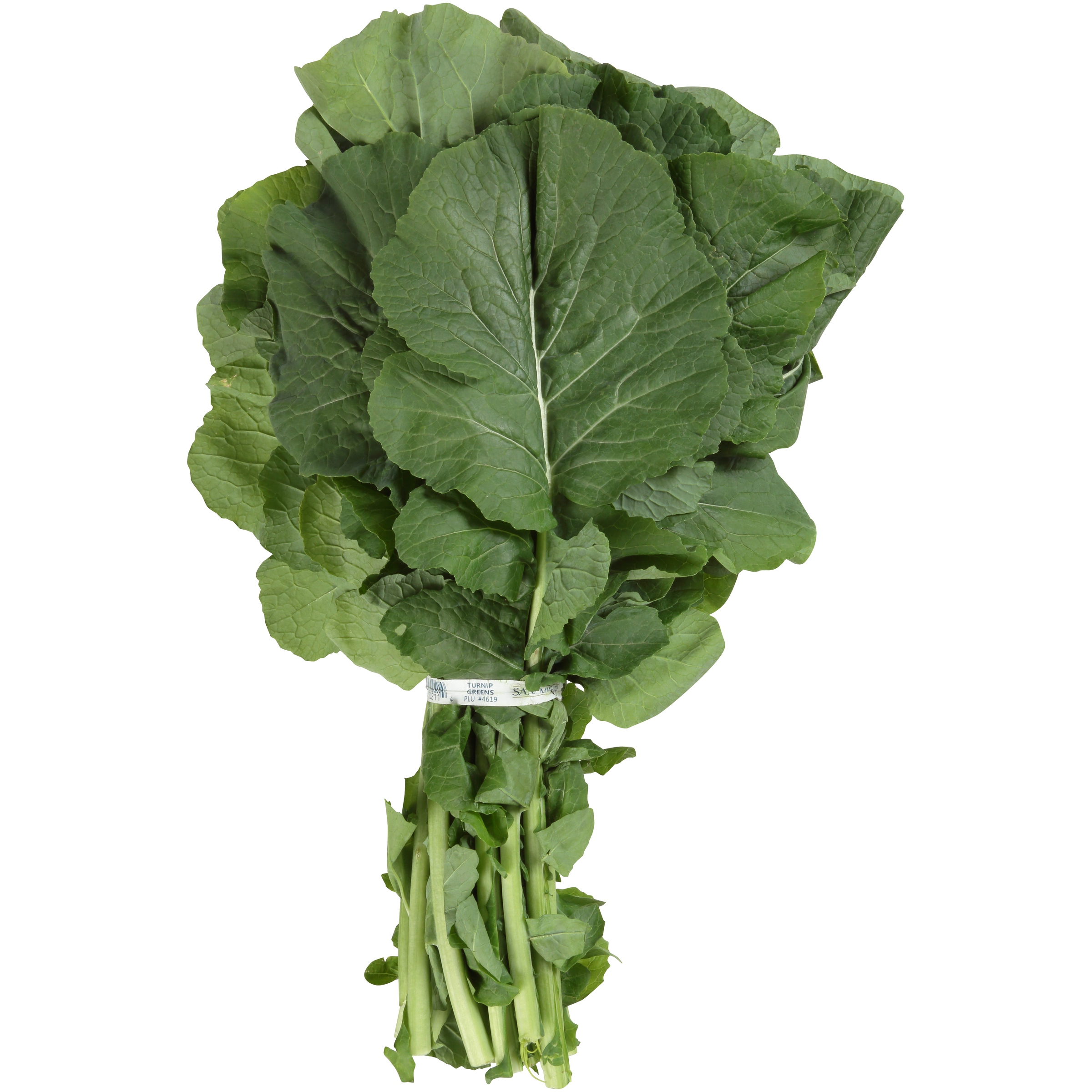
Turnip green bundle.
This week, while at a big box grocery, I picked up some turnip greens. It was really just on a whim. The leaves are big and dark green. This was a fatal error. I placed a few leaves of turnip greens into each of the growth chambers. Immediately the grasshoppers began to devour the leaves. I usually check on the grasshopper chambers every few hours. When I returned I noticed several of the grasshoppers in the chamber with the higher population behaving erratically. Some were on their backs, others had legs that were quivering. There were many that appeared to be dead. Upon closer examination, a few of the older grasshoppers were noticeably sick as well.
Grasshoppers having a meal.

The high density chamber had consumed all of the turnip greens I had given them and I was preparing to give them more. Based on the observations, I gave that a second thought. I remembered a research publication I had read that detailed experimentation with growing grasshoppers in captivity. I recalled that one particular paper pointed out the problem with some of the greens that were feed to their grasshoppers had been contaminated with pesticides and resulted in deaths of their stock. This is likely what had just happened to Thoptera's largest batch of grasshoppers hatched to date. I quickly removed what was left of the turnip greens in all of the growth chambers. I hoped that all of the grasshoppers hadn't indulged in the juicy leaves. I would have to wait until morning to see what the final death toll would be. 
Grasshoppers were piled in quantities of 10 to obtain a death count.
Morning revealed mass casualties. Over 150 of the large batch had died or were near death. Several of the December group had died as well. Thankfully these were nearing end of life anyway. Without a doubt though, some potential egg pod production was lost. There are still around 100 left of that large group. A few more may die still, but hopefully the carnage has ended!
Deceased grasshoppers from presumed pesticide contamination.

Lesson learned. From now on, stick to a tried and proven variety and brand of lettuce (greens). If I want to experiment with a new feed type or source, I always need to try it out on a small test group of grasshoppers.

Saturday, March 14, 2020

More Hatchlings...

Hundreds of grasshopper nymphs.
We had lots of new hatch-lings this week. It will be interesting to see how many survive. Plenty of moisture is key for hatching.


Thursday, March 12, 2020

Thoptera Growth

Thoptera, the only US commercial grasshopper breeding operation (as far as we know) is ramping up....

The first generation of hatched Melanoplus differentialis (Differential) grasshopper nymphs are reaching maturity. Several are now starting to lay egg pods.

Differential Grasshoppers basking in an incandescent heat bulb. Some are attached to the outer wall screen. Others are perched on a wire basking frame inside the growth chamber. Romaine lettuce can be seen in the foreground, which presently serves at the primary grasshopper food source.

Learning & Experimentation

Much has been learned over the last few months. Initially LED "daylight" light bars were being utilized for 14 hours per day in each grow chamber. A ceramic heat emitter (no light source) was being used to provide heat for the grasshoppers 24 hours per day. The first group that was hatched in captivity was undersized and the color of the grasshoppers was very pale, almost translucent white. 

Recently, the ceramic heat emitters were replaced with incandescent bulbs (75 to 100 Watt) to provide heat and UVA basking. These are left on 24 hours per day currently. In addition, a UVB bulb has been added to each growth chamber. These are programmed to remain on for about 14 hours per day, mimicking natural daylight hours.

This change immediately resulted in larger and more naturally colored grasshopper.


Differential Grasshopper laying egg pods.
There are still several American Grasshoppers (Schistocerca americana) still alive from when they were caught in the wild in the late summer months. They have been living in captivity for nearly 6 months. They have laid egg pods, but to date, none have successfully hatched. 

American Grasshopper attempting to lay eggs in sand tray inside growth chamber.
 One grasshopper has been repeatedly drilling egg pod holes in the sand trays located inside the growing chamber.
American Grasshopper loitering around inside the growth chamber.

What's next?

Several batches of egg pods are in the incubation queue. Many will be hatching in the coming weeks. This is where exponential population growth should occur.

In addition, more will be wild caught during the next few months as well. 


Tuesday, February 11, 2020

Thoptera

It's official.... Thoptera now has a website. www.thoptera.com Thanks to my business partner for setting that up and also for the cool new email address: john@grasshopper.farm How cool is that?!?!

Still been feeding grasshoppers everyday and hatching some new ones. Things should explode exponentially in the coming months. Still much experimentation, with more to come in the months ahead. The initial batch that was hatched in December is now beginning to breed and lay eggs. Here are a few photos of those.


I believe they are Melanoplus differentialis (Differential grasshoppers). I think I have a few Schistocerca americana as well in captivity. Some of the nymphs may be of that type as well. As they grow, it will be easier for a non-entomologist (like me) to identify them. 

I have noticed that these have not gotten as large as their parents, who were caught wild in the Fall (2019). I suspect that the diet and lighting may be the culprits. I will need to tinker more with lighting to see if that helps. I hope to have a greenhouse type structure, at least a building is many windows on the South side of the structure, to give them plenty of natural light year round. Light in the wintertime will need to be supplumented.

There is a major locust outbreak in Africa going on currently. 


Thursday, January 9, 2020

Thoptera Grasshopper Operation Ramping Up

Progress with the Thoptera grasshopper growing operation is ramping up. I posted in the fall about my interest in starting an alternative protein business focused on mass rearing of grasshoppers here in the U.S. In my research, I have yet to find a company in America that is involved in commercial grasshopper production. If you know one, please post in the comments. My aim is to continue working to optimize year round production of grasshoppers for human consumption and for agricultural feed purposes (poultry and aquaculture). Earlier posts contained pictures of grasshoppers that had been captured in the wild and then caged to breed. After some research and lots of trial and error to getting them to hatch I successfully hatched out a few dozen in December (obviously not within the normal seasonal hatching in North America). If all goes well, the next generation with yield several hundred, and the generation after that will be in the thousands by summer. This would allow for direct to consumer sales initially with a more commercial type operation to follow. I am sure there will be several more things to learn over the next few months, especially as the quantity increases. The goal is to have a commercial, year-round production system in place by next fall that can be scaled for growth as demand increases.
Check out this video of one group of itty-bitty grasshoppers emerging from their eggs in my "desktop hatcher."
Here is a photo of the same grasshoppers a few weeks later in the growth chamber.
The following photo shows the grasshoppers that were caught in the wild about 6 months ago.
 

Thursday, October 3, 2019

Swarms of grasshoppers

This year there was a swarm of grasshoppers in Las Vegas.
They were piled high there. It shows just how densely they can be congregated. These folks even rounded up a few to cook up and eat (although the newscasters didn't like the idea):
This next video really explains the swarming phenomenon well. It has really great video footage as well. Can we say Biblical?!!!?? The ability for them to be in close quarters may be beneficial in raising them in a closed environment on a large "industrial scale."

People around the world consume grasshoppers/locusts. The problem is that many of these "wild" grasshoppers are likely contaminated with pesticides/insecticides and other agricultural chemicals.
Central Americans especially love grasshoppers, called Chapulines! Many are imported to the U.S.! This silly video does a good job describing the basics of it....

One guy said "they taste like bacon bits." 😎😀😀

These videos help support the idea that I believe there is a market in the U.S. for commercially grown grasshoppers. I am still waiting for my little "swarm" of grasshoppers, which include several types, to multiply. They have been mating and laying eggs, which are now nearing week 2 in the incubator. I will provide an update on when/if there is success in hatching out baby grasshoppers!

In the meantime, here is a pic of one that sadly reached end of life while in captivity. It gives you a good idea of the size.


Monday, September 23, 2019

Insect agriculture

I have been researching and tinkering with an idea that is new to me, but has apparently been a "thing" for several years: insect agriculture. There a good number of players in the space, most focusing on mealworms or black soldier fly larvae as protein sources. This article helped to spark my interest in the farming of insects: https://agfundernews.com/funding-insect-startups-slow-start-despite-demand.html. This article was a good one as well: https://agfundernews.com/inside-insect-farming.html.  It speaks to the need for automation in the space and how it drives growth. This is what has peaked my interest in the space. After some research on the topic (what I enjoy doing) and looking at the latest news and trends I took the plunge and started my own grasshopper "farm". My family and I have been rounding up grasshoppers from our small plot of land.
Here are a few photos and a video of our first grasshopper box....


We have captured several types of grasshoppers and have now begun the incubation process, attempting to hatch out new grasshoppers in captivity.

So why grasshoppers? I came across an Israeli company, Hargol, that happens to be the world's first and only commercial scale grasshopper producer. After reading up on grasshoppers, it was apparent that they would be a good challenge. Plus, they are also in demand. In Mexico, grasshoppers are a sought after critter. When prepared for human consumption they are know as Chapulines. I anticipate that there will be a sufficient demand in the southern US given that there is a large Hispanic population. Granted, the grasshoppers we are growing are not the native variety found in Mexico and Central America, but maybe these will be a good substitute  as "American Chapulines." Beyond direct human consumption they can also be made into protein powder/meal for use in both human, animal, and fish feed. Think tilapia, shrimp, and chickens. They could even be dried and feed whole to poultry.
So that is a rundown of a new adventure here at Mt. Pelia Innovative Solutions. Plans are already in the works related to how to scale up. I love to come up with company names. One that I like for this business is "THOPTER". This is derived from the insect order Orthoptera which includes locusts, crickets, and grasshopper.
What do you think of this new venture? Would you try a roasted grasshopper? How about a smoothie made with insect protein powder? Let me know in the comments section.
-John